Noisy Neighbours UK Disputes: Legal Options & How to Resolve Them
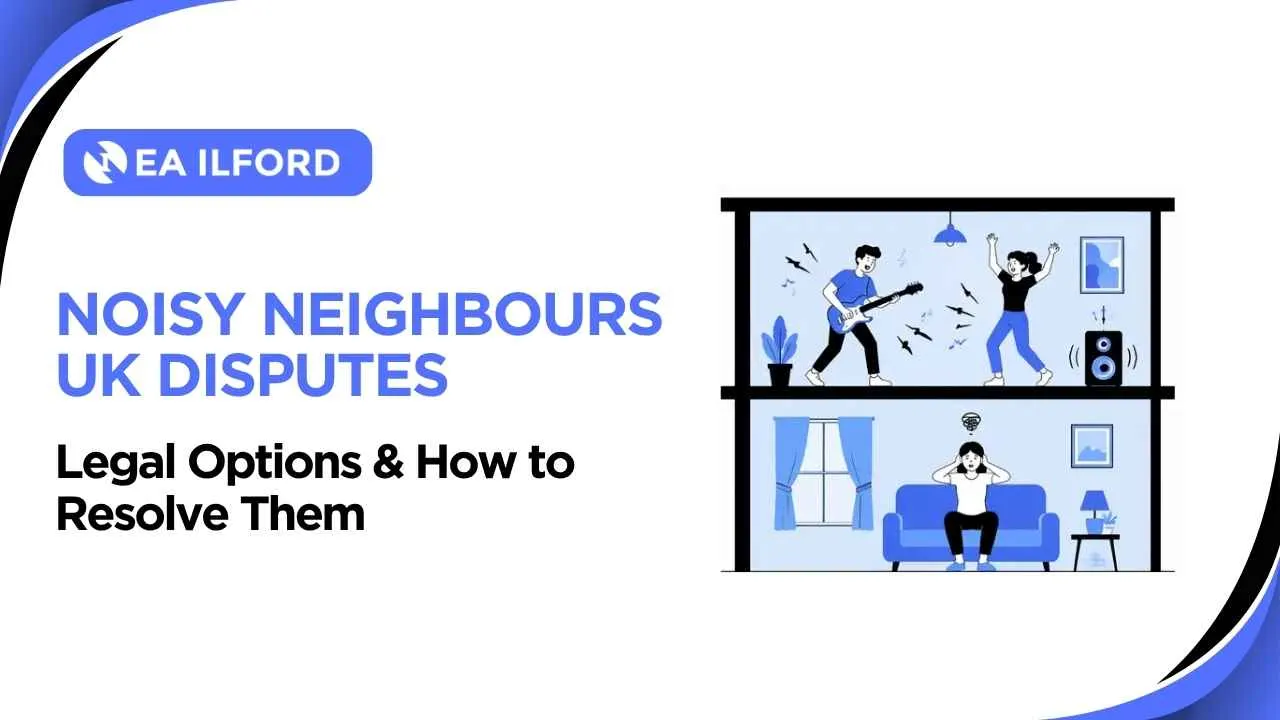
Under UK law, a noisy neighbour can be classified as a statutory or private nuisance. You have the legal right to report, dispute and resolve it. Neighbour noise can affect your lease and the value of your property, and you have legal protection as a homeowner, landlord, as well as a tenant against noise nuisance. Speak to your neighbours first, and then go for legal procedures if the issue is not resolved.
From informal resolution to court action, Estate Agents Ilford can tell you what options are available, how to take action and what it means to landlords in London.
| Disclaimer: We are estate agents, not solicitors. This guide is intended as general guidance and should not be treated as legal advice. We always recommend consulting a licensed solicitor before taking legal action. |
Is Noisy Neighbour a Legal Nuisance in the UK?
Yes, a noisy neighbour is considered a legal nuisance in the UK if it meets the threshold of a “statutory nuisance” under the Environmental Protection Act 1990.
What Counts as Noisy Neighbours UK: Legal Threshold
Not every sound qualifies as a legal nuisance. A neighbour having a one-off birthday party is very different from one blasting music daily at 2 AM. Therefore,
Noise Nuisance is any sound that substantially interferes with your ability to enjoy your home. Under UK law, for noise to be legally recognised, it must be loud enough, frequent enough, and disruptive enough to affect your health and quality of life.
Is There A Law About Noise After 11 PM?
Yes, but there is no single law that makes noise after 11 pm automatically illegal. Instead, noise after 11 pm falls under a combination of the given Acts:
- The Noise Act 1996 specifically addresses excessive noise from dwellings at night, defined as between 11 PM and 7 AM.
- The Environmental Protection Act 1990, which covers statutory noise nuisance.
- The Anti-Social Behaviour, Crime and Policing Act 2014 gives councils and police the power to act on noise nuisance.
- Local council bylaws: Most councils set their own quiet hours, which are commonly 11 PM to 7 AM.
Any noise that exceeds permitted levels during this time can be reported to councils, which have legal powers to investigate and take legal action.
| What are permitted noise levels at night in the UK? The permitted noise level in the UK is: 34 dBA if the background noise is no higher than 24 dBA.10 dBA above background if it exceeds 24 dBA 34 dBA is roughly the level of a quiet conversation or a refrigerator hum. Loud music, shouting or heavy bass normally exceeds this limit inside your home. Source: GOV.UK: Noise Nuisances: How Councils Deal With Complaints |
Does the 11 PM Rule Apply in London?
The rule of quiet hours applies in London but varies depending on the borough you live in. All London boroughs are legally required to investigate noise complaints, but the threshold of 11 PM enforced differs.
For example,
- Hackney Council actively enforces night noise. They can issue abatement notices and can seize noise-making equipment if warnings are ignored.
- Hammersmith and Fulham has a dedicated Noise and Nuisance team who can issue fixed penalty notices and community protection notices.
- Barking & Dagenham also has prosecuted noise nuisance offenders in court, resulting in fines of more than £1,300.
- Kensington & Chelsea has stated that times set in tenant agreements, like 11 pm to 7 am, cannot always be directly enforced by the council.

What Does Noise Nuisance Mean for London Landlords?
As a landlord, you are not directly responsible for the noise your tenants make. But if you are aware of noise complaints and fail to act, you could face:
- Legal Action from neighbouring residents
- Council enforcement against your property
- Damage to your rental reputation.
Most standard UK tenancy agreements include a quiet enjoyment clause. It protects your tenant’s right to live peacefully, but it equally expects them not to make life unbearable for those living next door.
If your tenant repeatedly breaches, you have legal grounds to issue a formal warning and serve a Section 8 notice citing anti-social behaviour.
Can A Landlord Evict A Tenant For Noise Complaints?
Yes, but not immediately. A single noise complaint is not enough for eviction. However, if the noise is persistent and documented, a landlord can serve a Section 8 Notice under Ground 14 of the Housing Act 1988. It covers anti-social behaviour, including noise nuisance. Landlords must have evidence, council records and written complaints from neighbours to do an eviction successfully on a fair basis.
Before issuing this notice, most landlords are expected to issue a formal warning first, which shows responsibility of the landlord and gives the tenant a chance to correct the behaviour.
Sources:
Repossessing your privately rented property after 1 May 2026 – GOV.UK and Housing Act 1988 Schedule 2

Your Legal Rights Under Noisy Neighbours in the UK?
Noise nuisance affects different people differently depending on their status regarding property, such as homeowners, leaseholders or renters.
Rights as a Homeowner
As a homeowner, you have the strongest legal standing when deciding on noise issues.
- You can report noise to your local council under the Environmental Protection Act 1990, which requires councils to investigate statutory nuisance complaints.
- If the council fails to act, you can apply directly to a magistrates’ court under Section 82 of the same Act.
- Homeowners also have the right to pursue a civil claim in nuisance against their neighbour if the noise has caused measurable damage to their health or enjoyment of property otherwise. This route is costly and typically a last resort, but it is a legal option available to homeowners.
Rights as a Tenant
As a tenant, your rights come from two directions: your tenancy agreement and housing law.
A tenancy agreement may include a quiet enjoyment clause, which gives the legal right to occupy property peacefully without interference. If a noisy neighbour is disturbing your normal living, you can report it to your landlord in writing and request that they take action.
You can also report to your local council, which will investigate complaints and take action.
Rights in a Leasehold or Flat
Leasehold situations are more complex because noise often travels through shared walls, floors, and ceilings. Most leasehold agreements contain a nuisance clause that prohibits leaseholders from causing unreasonable noise and disturbance to neighbouring flats.
If your neighbour breaches their lease, you can report to the freeholder or managing agent for formal enforcement action. If a freeholder fails to act despite repeated written requests, you can apply to the First-Tier Tribunal to take legal action. This is a significantly cheaper route than going to court, specifically for leasehold disputes.

How to Deal With Noisy Neighbours Step by Step?
The process to deal with noisy neighbours follows a similar path, even if you’re a landlord, homeowner or tenant.
Step 1: Keep a Noise Log
Before doing anything, you must start documenting the nuisance. Note the date, time, duration and nature of the noise incident. It becomes your evidence base for every next step to follow. Noise record may contain a written log, audio recordings or any written communication with your neighbours.
Step 2: Communicate Directly With Neighbours
The fastest and first step to resolve a noisy neighbour dispute is to speak to your neighbour directly. A calm, factual conversation is always the first recommendation. If you’re uncomfortable approaching them directly, a polite written note works just as well.
Step 3: Contact Your Landlord or Managing Agent
If direct communication fails, then the next step depends on your situation.
- Tenants will notify their landlord in writing.
- Leaseholders should contact their freeholder or managing agents
- Landlords who receive complaints from their tenants may issue a formal written warning.
Step 4: Report to Your Local Council
If informal routes have not worked, report to your local council. Councils have a duty under the Environmental Protection Act 1990 to investigate noise complaints that may constitute a statutory nuisance.
Provide your records and details of how noise is affecting your health and daily life.
Step 5: Mediation
Before stepping towards legal actions or court, mediation is worth considering. Many councils offer free or subsidised mediation services for neighbour disputes.- GOV.UK
How Council Deals With Complaints of Noise from Neighbours?
When you report a noise complaint to the local council, it will first assess whether the noise is likely a statutory nuisance. If accepted, an officer may visit or monitor noise levels directly.
If a nuisance is found, they must serve an Abatement Notice. If you ignore it, that’s a criminal offence; fines for domestic properties can reach £5,000. (gov.uk)
How Common Are Noise Complaints in London?
Noise complaints are very common all over the UK, especially in London.
Noise Action Week is an annual awareness campaign led by Environmental Protection UK, held every May. It highlights the health and social impact of noise pollution across the UK and encourages councils and landlords to take noise complaints seriously.
306,956 noise complaints were lodged during the period from October 2024 to September 2025 in England and Wales.
In London, the boroughs that received the largest number of complaints are:
| Rank | Local Authority | Noise Complaints |
| 1st | London Borough of Islington | 11,141 |
| 2nd | London Borough of Southwark | 10,785 |
| 3rd | London Borough of Hackney | 10,237 |
| 5th | Manchester | 9,336 |
| 7th | Birmingham | 6,654 |
| 9th | Leeds | 5,406 |
Selected local authorities from CEIH rankings
Source: CIEH Noise Complaint Data 2026 — cieh.org & IES Noise Action Week Data
It means the noise nuisance complaints are a routine part of managing residential property in a dense urban area.

How Noisy Neighbours Disputes Affect Property Value?
Noise from neighbour disputes can have a visible impact on both the sale price and rentability of a property.
Impact on Sales
The TA6 form requires sellers to disclose active noise disputes. It’s not optional and buyers do check. A documented noise dispute can reduce market value or cause potential buyers to withdraw.
Impact on Rentals
Tenants dealing with unresolved noise issues are more likely to leave, resulting in additional void periods. In severe cases, they may pursue a rent reduction claim citing breach of the right to quiet enjoyment.
Landlords who want to protect their rental income regardless of void periods can explore our Guaranteed Rent Scheme.
Impact on HMO Licences
Repeated noise complaints can trigger an HMO licence review. Councils can attach conditions or refuse renewal if antisocial behaviour is documented against the property.
Conclusion
Dealing with noisy neighbours in the UK residential property is a common issue. For landlords across London, noise nuisance is not just a neighbourly inconvenience. It carries real legal exposure, affects your rental reputation, and can impact your property’s value and HMO licence standing.
Document early, act in sequence, and take every complaint seriously, and it is always easier to resolve informally. For legal matters, always consult a licensed solicitor.