Decent Homes Standard by Renters Rights Act: 5 Criteria for Landlords
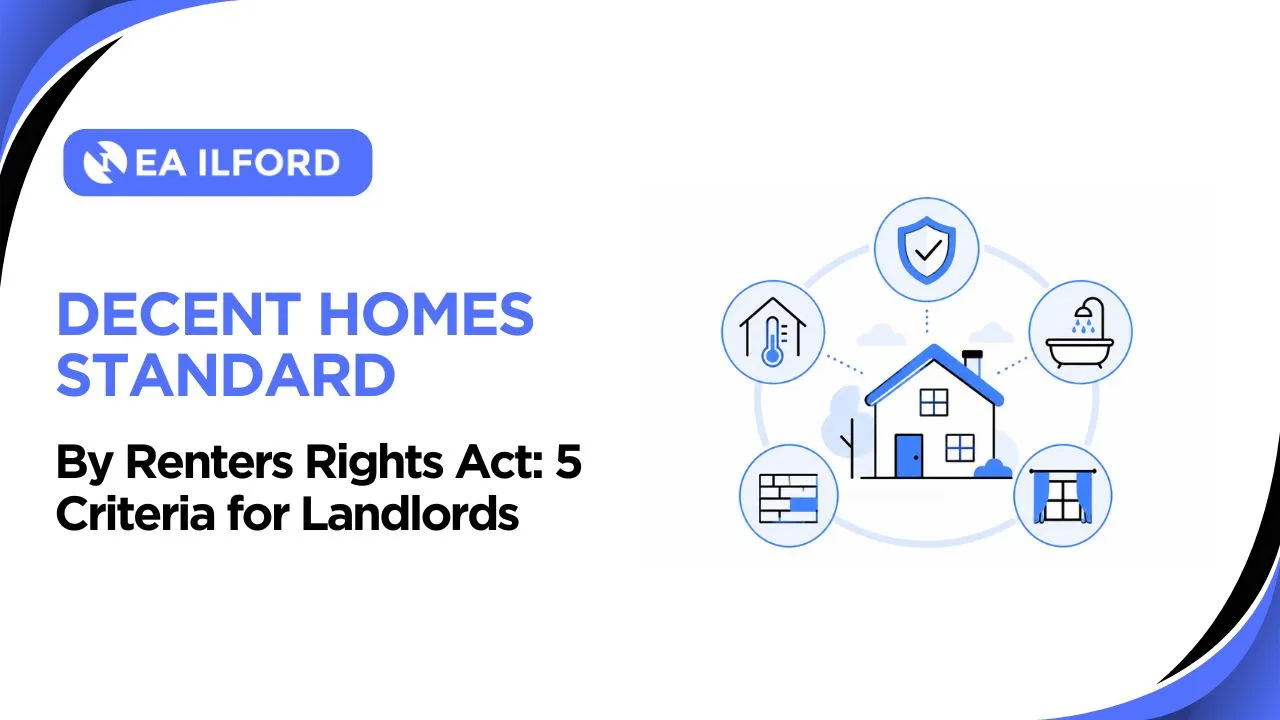
On 28 January 2026, the government confirmed exactly what the new Decent Homes Standard (DHS) will require. There are five criteria landlords must meet: hazards, repair, facilities, damp and mould, and energy efficiency. It will apply in the Private Rented Sector and social housing from 2035.
Ilford landlords will now work under two overlapping rulebooks. The first is Redbridge Council’s selective licensing scheme, covering Ilford Town and other wards, with its own conditions on gas safety, electrical checks, and EPC ratings. The second is the newly confirmed Decent Homes Standard under the Renters’ Rights Act(RRA).
Here’s what the DHS actually is, what changed this January, and what it asks of landlords.

What is Decent Homes Standard (DHS)?
The Decent Homes Standard is a legal minimum condition a rental property must meet in England. “It’s a standard that requires the property to be safe, warm, and in a good state of repair.”
It has been applied to social housing since the early 2000s, but the Renters’ Rights Act 2025 extends it to the private rented sector. It will apply to the private sector from 2035.
Every tenant has the right to live in a safe home. In Phase 3 of the Renters’ Rights Act, the DHS will be rolled out. The homes under new reforms will be safe, warm, free from hazards, and in a reasonable state of repair.
History of Decent Homes Standard
The DHS was first introduced for the social housing sector in the early 2000s. It established minimum housing quality and safety standards so that tenants living in Decent Homes Standard: What Landlords Must Do Bef…council and other social rented homes had access to safe, warm, and reasonably modern accommodation.
The standard was updated in 2006 to match the Housing Act 2004, which introduced HHSRS. The Housing Health and Safety Rating System sets standards to assess health and safety risks in homes.
A home in 2006 was considered decent if it:
- Met the minimum legal standard for housing
- Was in a reasonable state of repair
- Had modern core facilities and services (kitchen, bathroom, and insulation)
- Provided a comfortable level of warmth with effective heating systems.
In May 2023, the Renters ‘ Reform Bill was introduced by the Conservative Government, in which the extension of the DHS to the Private Rented Sector was planned. Subsequently, on 28 January 2026, the government published the policy statement, which requires Decent Homes Standards to be applied both in social and private rental sectors.

The New Decent Homes Standard: What Changed in January 2026
In January 2026, the government confirmed the New Decent Homes Standard. It provides a shared benchmark for social and private renting to identify, plan, and implement safety regulations in rented homes.
The new future homes standards will be implemented from 2035 in both the social and private sectors. The timeframe has allowed landlords to implement regulatory changes under the first two phases of the Renters Rights Act and prepare for the new DHS.
Additionally, the introduction of Awaab’s Law will require private landlords to make properties safe from damp and mould hazards, with implementation expected around 2027, subject to further consultation.
To be decent according to new standards, the properties must meet the five criteria.

5 DHS Criteria Landlords Need to Meet
To meet the DHS, a property must satisfy all five criteria simultaneously. Even if a single criterion is missed, the whole property will be considered non-decent.
Criterion A: Free from Category 1 Hazards
A home will fail Criterion A if it has Category 1 hazards under the Housing Health and Safety Rating System (HHSRS).
It is the criteria that are already implied for every rental in England. A category 1 hazard will be defined as anything that is serious enough to pose a serious risk to the health and safety of the occupants. It may include severe damp pushing through internal walls, electrics that haven’t been checked in years, an unsafe staircase, missing smoke detection, or a home so cold it’s a health risk in winter.
Landlords who are already keeping safety checks, EICRs, and fire safety are already on the way to follow DHS.
Note: Under HHSRS, hazards are scored on a band scale from A (most severe) to J (least severe). Bands A, B, and C count as Category 1 and anything in that range fails Criterion A outright
Criterion B: Reasonable State of Repair
If a single key building component of a property or two or more components are in poor condition, a home will fail Criterion B.
Key components include roofs, walls, windows, doors, electrics, and plumbing. In the old standard cared about the age; for example, in the kitchen, those over a certain number of years old failed automatically, but now, under the new standard, it will be purely about condition.
For landlords, it works in their favour. If they keep proactive maintenance, they don’t need to replace them after a certain age has passed.
Criterion C: Core Facilities and Services
The property (house) must meet at least 2 of 3 core facility criteria. A proper kitchen, a well-placed bathroom and toilet, a decent noise insulation system, and for flats a shared entrance.
Flats need 3 of 4 (kitchen, bathroom/WC, noise insulation, plus shared entrance).
There are two things to know.
- First, noise insulation is not a rule; it’s part of the criterion, and a facility is counted here.
- Second, there’s a new rule in this criterion, which is restrictions on windows above ground level that a child could reach from standing. This applies whether a tenant has a kid or not.
Criterion D: Warm Enough
The property/homes need to meet minimum Energy Efficiency Standards (MEES) and have a heating system that can warm the whole home, with manual controls for tenants.
This deadline is hitting before DHS. The full Decent Homes Standard will be enforced in 2035, but the EPC C rating arrives on 1 October 2030, five years sooner. Don’t wait to sort out energy efficiency.
Criterion E: No Damp or Mould
The criterion demands that a home fails if damp or mould is assessed as serious under the HHSRS band.
This is a significant addition. Right now, it doesn’t exist as a criterion until the new standard takes effect. Currently, damp and mould hazard onyl matters if it’s bad enough to count as a Category 1 hazard under criterion A. Under Awaab’s law, there are strict timeframes that landlords need to follow to investigate and repair damp and mould issues.
HHSRS scores range from A (worst) to J (mildest). Almost any score, down to H means the property fails Criterion E. Only I and J, the two lowest bands, pass. So even mild-looking mould can fail it.
Self-Audit: Is Your Property DHS-Ready?
Run each property against these before full guidance lands.
Criterion A
Criterion B
Criterion C
Criterion D
Criterion E
How the Standard Will Be Enforced?
Local councils will enforce the DHS, using the same authority they use for housing inspections, improvement notices, civil penalties, and prosecution (in serious cases).
Local authorities will inspect properties for DHS, and landlords will be legally responsible for ensuring that properties comply. To support enforcement action, the government decided to increase the civil penalty for non-compliance( £7,000 to £40,000). The council can issue a fine of up to £7,000 for a serious breach by landlords to address the issue.
Cost to Upgrade Homes
According to a recent survey, a report stated that to bring a non-decent property to a decent property standard, the average cost could be £10,586, with a median cost of £4,222. Costs can vary depending on the condition of the home, location, type, and level of maintenance.

How DHS Overlaps With Landlord Licensing In Ilford?
If your property is in Ilford Town, Valentines, or one of the other licensed wards, you are already required to hold gas, electrical, and EPC evidence under Redbridge’s selective licensing scheme.
Redbridge council runs two selective licensing schemes covering part of Ilford. Scheme 3 covers Ilford Town and Valentines wards and runs until 31 October 2028. Scheme 4 covers an additional 15 wards, including Barkingside, Goodmayes, Seven Kings, and Wanstead Village, and is scheduled to run until 7 April 2029.
Here is where DHS and licensing requirements overlaps.
To get a license for each scheme, landlords need to supply a current gas safety certificate, a satisfactory EICR, and an EPC. It means that Ilford landlords are already ahead of most areas on DHS. But this licensing alone won’t get you pass DHS deadline. Damp/mould and the facilities criteria sit outside what selective licensing currently demands.

Exemptions for Decent Homes Standard
The government has confirmed three main exemptions:
- Tenant refusal of access: if a landlord can’t get entry to carry out required works because the tenant won’t allow access, it will be recognised as a valid reason for non-compliance.
- Existing MEES exemptions: if a property holds a valid Minimum Energy Efficiency Standard exemption, for example, after spending up to the £10,000 cost cap without reaching EPC C, that will be recognised as an exemption under DHS.
- Physical or planning constraints: structural limitations or planning restrictions preventing certain works, this is accepted as an exemption ground.
Additionally, purpose-built student accommodation (PBSA) that complies with code of practice, such as ANUK/Unipol National Codes, sits outside the DHS framework entirely. This exemption isn’t permanent and can be lost if the provider stops complying with the code.
| What’s notably not an exemption ground for DHS? Two things landlords sometimes assume will excuse them: First, cost on its own doesn’t count, and neither does “I didn’t know about it.” There is already a £10,000 cap on what landlords can spend on energy efficiency work. Once they have spent up to that cap, you can apply for an exemption. But landlords can’t skip the work just because you’d rather not pay for it. Second, not being aware of the requirement isn’t a valid excuse either. |

How Estate Agents Ilford Helps Landlords?
Our property management service is built around the same compliance areas the DHS requires. So, Ilford landlords with us are largely ahead of the 2035 deadline without extra work.
Get DHS-Ready with Estate Agents Ilford’s Property Management.