How To Apply For Disabled Facilities Grant UK: Home Adaptation UK
Most people in the UK who may qualify for a Disabled Facilities Grant never apply. Even some don’t know it exists, and others assume they won’t be eligible. A few started the process and gave up. Disabled Facilities Grants (DFG) are approved in England every year. Countless eligible households never apply. The grant covers up to £30,000 in home adaptations. If you are facin same issue, we are here to guide you about DFG
Estate Agents Ilford will help you find suitable properties for home adaptations, as they know which homes already have the necessary features to make them safe for living.
Who Can Get a Disabled Facilities Grant (DFG) in the UK?
A Disabled Facilities Grant is available to people in England, Wales, and Northern Ireland who have a disability and need changes made to their home to live more safely and independently. Scotland runs its own separate scheme through local councils.
| What is a Disabled Facilities Grant? A Disabled Facilities Grant (DFG) is a government-funded grant available in England, Wales, and Northern Ireland that helps disabled people pay for adaptations to their homes. It is not a loan. You do not pay it back. And crucially, it is mandatory, which means if you meet the eligibility criteria, your local council is legally required to grant it. |
You can apply if you are:
- Owning your home
- Owner-occupier
- A private tenant
- A landlord with a disabled tenant
- A local authority tenant
- A housing association tenant
Eligible Disabilities for Home Adaptations Grants
The disabilities are always not physical to qualify, you may be eligible if you:
- Have a physical disability
- Have a learning disability
- Have needs related to ageing
- Are autistic
- Have a cognitive impairment, such as dementia
- Have a progressive condition, such as motor neurone disease
- Have a terminal illness
- Have a mental health condition that affects your ability to live safely and independently at home
It is administered by local councils and usually starts with an occupational therapist assessing your needs at home.
How to Apply for Disabled Facilities Grant in the UK?
You can apply through your local council. The council may send an occupational therapist or trained assessor to visit and assess what home adaptations are needed.
You can apply online through apply disabled facilities grant by entering your postcode to find your local council. In Northern Ireland, apply through the NI Housing Executive instead.
You can also self-refer directly to your council’s housing or be referred by your GP (general practitioner) or hospital OT.
If you need help with the application, the government funds an organisation called the Foundations. They respond to questions on all sorts of questions from how to apply to the general DFG rules.
| Complaints If your application is delayed, refused, handled poorly, or you don’t get a decision within 6 months, always ask for the response in writing from the council first, as it helps if you need to take things further. There is no formal appeal process written into law, but councils should review decisions if you disagree. If you are still unhappy, you can take your case to the Local Government Ombudsman for most DFG complaints, including delays, poor service, or unfair refusal. |

What Does the Council Look At for Disabled Facilities Grant?
To qualify, the council needs to be satisfied that you are disabled. That usually means you have a physical or mental impairment that has a substantial and long-term effect on your ability to carry out day-to-day activities.
They perform a complete assessment of whether you can:
- Get in and out of the property safely
- Use the bathroom without help
- Move between floors
- Prepare food independently
- Reach heating and safety controls
It is the same broad definition used under the Equality Act 2010. You do not need to be receiving a specific benefit to be considered disabled for this purpose. Children can qualify, too. A parent or guardian applies on their behalf, and the same means test applies to the household.
Crucially, the adaptation must be necessary and appropriate for your needs. It must also be reasonable and practicable to carry out, given the age and condition of the property. Both criteria have to be met.
There is no means test for disabled children or for people receiving certain passported benefits. In those cases, the financial assessment may be skipped entirely or result in automatic maximum funding.
| Means Test for DFG Qualification For most applicants, the council then carries out a financial assessment to decide how much grant you are entitled to. They look at your income, savings, and, for homeowners, the equity in your property. The means test is handled separately from the needs assessment, and one does not affect the outcome of the other. |

What Home Adaptations Does a DFG Cover?
A DFG covers home adaptations that have been formally assessed as necessary for your specific situation. You will get funded based entirely on what the occupational therapist recommends after visiting your home. According to gov.uk, eligible adaptations include:
- Widening doors and installing ramps or grab rails
- Improving access to rooms and facilities, for example, a stairlift or level access shower
- Improving access to your garden
- Building an extension, such as a downstairs bedroom
- Providing a heating system suitable for your needs
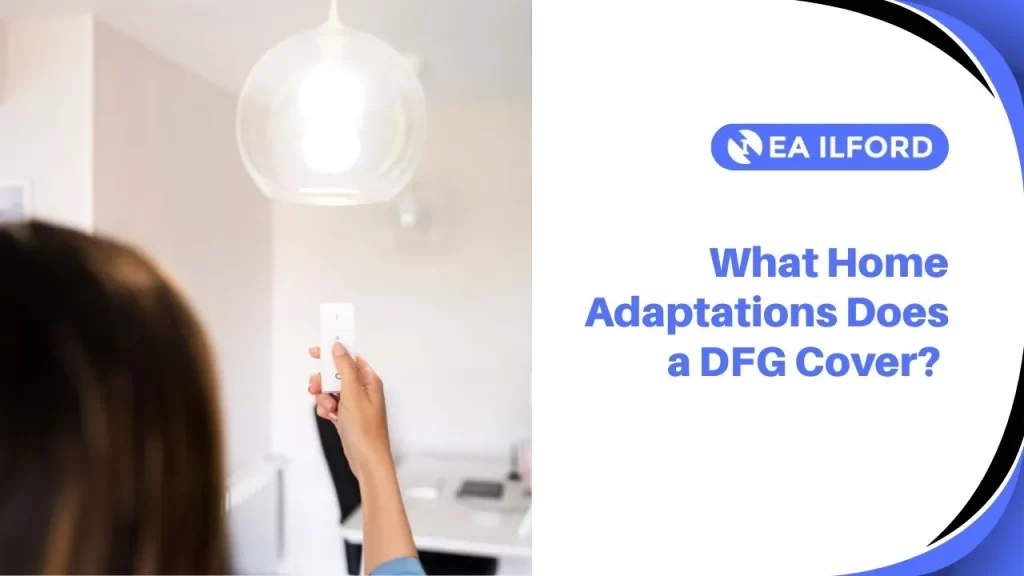
- Adapting heating or lighting controls to make them easier to use
How Much Money Will You Receive Under DFG?
The maximum is a cap, not a guaranteed payment. How much you actually receive depends on the income and savings of the disabled person and their partner. The first £6,000 of savings is ignored entirely.
If your income and savings fall below the threshold, you pay nothing, and the grant covers the full eligible cost up to the maximum. If your finances are above the threshold, you contribute the difference.
There is no means test when the application is made for a child or young person under the age of 19. In those cases, the full cost is covered up to the cap, regardless of household income.
| Nation | Maximum Grant | Administered By | Means Tested |
| England | £30,000 | Local council | Yes,(not for under 19s) |
| Wales | £36,000 | Local council | Yes (not always for smaller grants) |
| Northern Ireland | £25,000 | NI Housing Executive (NIHE) | Yes (not for under 19s) |
Northern Ireland’s cap has been subject to periodic review.

Important: Do Not Start Work Before Council Approval
You may not receive any grant if you start doing changes on your property before the council approves the application. This is one of the most common and costly mistakes people make.
If the work is urgent, contact the local authority to discuss this before starting anything. They can sometimes fast-track assessments in genuine emergencies. Also note that you may need to apply separately for planning permission or building regulations approval, and the council may ask you to employ a qualified architect or surveyor whose fees can be covered by the grant if approved.

A Pro Tip: Speak to Your Council’s OT Department Before You Buy Property or Apply
If you are thinking of moving and need adaptations, speak to your council’s occupational therapy team before you commit to a purchase. They can give you a realistic view of how suitable a property is for your needs and how likely adaptations are to be approved as reasonable and practicable.
Because some properties simply are not worth adapting, and finding that out after you have bought is an expensive lesson. You may disqualify for a DFG even if the other criteria are met.

Wrapping Up
The disabled facilities grant or home adaptations grant helps disabled persons to make changes in the property so that they can easily live there. You can apply for DFG through your local council or online through the government website.
Decisions are not always immediate; they take time. So, don’t start work on your property until you get approval from the local council. You need separate planning permission to make changes to your property. The required work should be completed within 12 months of grant approval.